
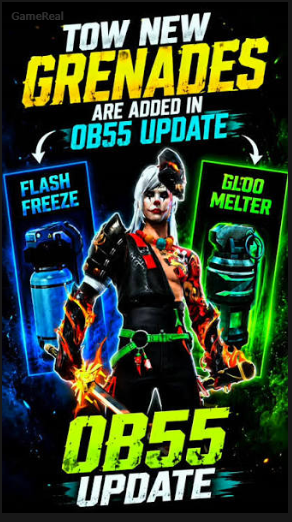
Free Fire OB55 Flame & Sonar Grenades: Full Guide
OB55 introduced two new throwables to Clash Squad that meaningfully expand the tactical options available in the mode: the Flame Grenade and the Sonar Grenade. Both arrived as part of a broader throwable update that also adjusted the existing Smoke Grenade. Together they give players new ways to control space, gather information, and break entrenched positions.
This guide explains exactly how each grenade works, when to use them, how they interact with common Clash Squad situations, and the practical habits that separate effective users from players who simply throw them on cooldown.
Why These Two Grenades Matter
Clash Squad has always been a mode defined by short rounds, limited economies, and the constant need to take or hold small areas of the map. Classic grenades already played a role, but the toolset felt relatively narrow. The Flame Grenade adds strong area denial and structure damage. The Sonar Grenade adds reliable information without requiring a full UAV or similar device. When used together or in combination with the updated Smoke Grenade, they create clearer attack and defense executes.
Understanding the numbers and the timing windows is more important than treating them as simple damage or “scan” buttons.
Flame Grenade – Complete Breakdown
Core Function
The Flame Grenade creates a burning area on the ground after it lands. The fire lasts for six seconds and expands during the first second after impact. Any enemy standing inside the flames takes 16 damage and loses 10 percent armor durability every 0.5 seconds. Allied players caught in the same fire also take damage, though at a reduced rate of 8 damage plus the same 10 percent armor durability loss every 0.5 seconds. The flames are especially effective against Gloo Walls, dealing 100 damage to them every 0.5 seconds.
Practical Implications
Because the fire damages both health and armor while also melting Gloo Walls at a high rate, the Flame Grenade is excellent for forcing players out of held angles or destroying hastily placed cover. The fact that it also hurts teammates means you must be careful with placement. Throwing it at your own feet or into a tight chokepoint your squad is about to push through can backfire.
Best Uses
- Clearing common defensive corners and head-glitch positions
- Destroying Gloo Wall clusters that block a plant or a push
- Cutting off rotation paths so the enemy cannot freely reposition
- Softening a site before a coordinated execute
Common Mistakes
Many players throw the Flame Grenade too early or into open space where the enemy can simply walk around it. Others forget the friendly-fire component and damage their own squad during a retake. The most effective throws are those that land just behind cover the enemy is using or directly on top of a Gloo Wall line they are relying on.
Timing Tips
The expansion happens in the first second, so there is a brief window where the fire is still growing. Landing the grenade slightly before your team commits often produces better results than throwing it at the exact moment you swing. In post-plant situations the lingering six-second duration can be used to delay a retake or force the enemy to take damage while defusing.
Sonar Grenade – Complete Breakdown
Core Function
The Sonar Grenade scans enemies within a 10-meter radius of its explosion point and reveals their locations for three seconds. It is designed as an information tool rather than a damage tool. The scan works through cover, making it valuable for checking common angles, confirming whether a site is held, or locating players who are playing unusually passive.
Practical Implications
Information wins rounds in Clash Squad. Knowing exactly where the enemy is standing for a three-second window allows your team to pre-aim, decide whether to push or fall back, and avoid walking into unfavorable fights. Because the radius is limited to 10 meters, placement still matters. A Sonar Grenade thrown into an empty area or too far from likely enemy positions wastes the utility.
Best Uses
- Checking a bombsite or common defensive setup before committing
- Locating enemies playing behind cover or in unusual spots
- Supporting a teammate who is about to swing an angle
- Gathering information during a retake or after hearing footsteps
Common Mistakes
Players often throw the Sonar Grenade too high or too far, causing it to land outside the useful radius of the actual fight. Others use it reactively after already taking damage instead of proactively before the engagement. The three-second reveal window is short, so the team must be ready to act on the information immediately.
Timing Tips
The strongest value comes when the Sonar Grenade is combined with a coordinated push. One player throws the scan while the others prepare to swing the revealed angles. In defensive rounds it can be used to check whether the attackers are stacking a particular path. Because it does not deal damage, there is almost no downside to using it when you have uncertainty about enemy positions.
How the Two Grenades Work Together
The real strength of the new throwable set appears when Flame and Sonar are used in sequence or in combination with the updated Smoke Grenade.
A common effective pattern looks like this:
- Sonar Grenade to confirm enemy positions
- Flame Grenade to force them out of cover or destroy Gloo Walls
- Smoke or direct swing while the enemy is displaced and damaged
Alternatively, a Flame Grenade can be used first to create panic or force movement, followed by a Sonar Grenade to track exactly where the enemies relocated. Both approaches turn the two new tools into a small tactical system rather than isolated utility.
Map and Situation Considerations
On tighter maps or sites with heavy Gloo Wall usage, the Flame Grenade gains extra value because structure damage becomes decisive. On more open layouts the Sonar Grenade often provides higher impact by removing uncertainty across longer sightlines.
Economy also matters. In early rounds when teams have limited funds, deciding whether to invest in one of these grenades versus extra armor or a better primary weapon becomes a real choice. Later in the match, when money is more available, most coordinated teams will want at least one player carrying each type of utility.
Adjusted Smoke Grenade Context
OB55 also updated the regular Smoke Grenade so its effect now matches the Smoke Vortex available in the Tactical Market. This creates a more consistent smoke experience across different sources and makes smoke plays more predictable. When combined with Flame and Sonar, teams now have clearer tools for vision denial, area denial, and information gathering.
Practical Habits That Improve Results
- Communicate the throw. Calling “Sonar on A main” or “Flame on the default Gloo” lets teammates prepare.
- Watch the landing point. Both grenades reward precise placement more than simply getting them into the general area.
- Respect friendly fire on the Flame Grenade. Clear your teammates before using it in tight spaces.
- Act on Sonar information immediately. The three-second window disappears quickly.
- Practice the lineups in custom rooms or less serious matches so the motion becomes automatic in ranked.
Final Thoughts
The Flame Grenade and Sonar Grenade are two of the more interesting utility additions Clash Squad has received in recent seasons. One controls space and destroys cover. The other removes uncertainty and enables better decision-making. Neither is complicated on paper, yet both reward thoughtful placement, timing, and coordination with teammates.
Players who treat them as simple “throw and forget” items will see only average results. Players who learn the effective ranges, the friendly-fire risk on flames, the short but powerful reveal window on sonar, and how to sequence the two grenades together will notice a clear improvement in their ability to take sites, hold angles, and win close rounds.
OB55 gave Clash Squad a clearer tactical language through these tools. Learning to speak that language fluently is one of the fastest ways to gain an edge while the rest of the lobby is still adjusting.