
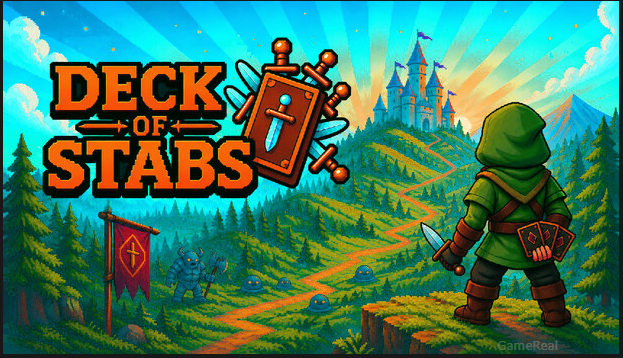
Deck of Stabs Release Date: 250+ Weapons & Heroes
Deck of Stabs is an upcoming roguelike deck-builder built around a simple but unusual idea: every card in your deck is a weapon. Instead of collecting traditional spell cards, defensive cards or ordinary ability cards, players build an arsenal of blades and other weapons and use them to fight through dangerous worlds.
Developed and published by RetroAction Games, Deck of Stabs is scheduled to launch on PC through Steam on September 30, 2026. The game combines turn-based strategy, deck-building, RPG progression and roguelike replayability, while giving players four different heroes and more than 250 weapon cards to discover.
The large weapon pool is only one part of the game. Players can equip items, learn skills, brew potions, modify weapons and create different builds around each hero. There are also five worlds containing their own enemies and bosses, along with challenges, secrets and achievements.
That makes Deck of Stabs more than a game built around collecting a large number of cards. Its main appeal is how those cards, hero abilities, items and upgrades interact to create different strategies from one run to another.
Deck of Stabs Release Date
The Deck of Stabs release date is September 30, 2026, when the game is scheduled to launch on Steam for Windows PC. The developer announced the date in September and described the release as the culmination of a long solo-development project.
Before launch, players can also try the available demo.
This is useful because Deck of Stabs is a systems-heavy game. A trailer can show the pixel-art presentation and combat, but playing the demo gives players a better understanding of how weapon cards, hero abilities and deck-building decisions work.
SteamDB currently records the PC release as September 30, 2026 at 13:00 UTC and lists Windows as the supported system.
At the time of writing, the game has not yet accumulated user reviews on Steam, so claims about its final player reception would be premature.
What Is Deck of Stabs?
Deck of Stabs is a roguelike deck-builder where the deck represents the player’s arsenal.
The basic concept is easy to understand.
You choose a hero, build a collection of weapon cards and use those cards during encounters. As the run progresses, you discover additional cards, items and abilities that can change the way your character performs.
The game then adds the unpredictability associated with roguelike design.
Rather than following exactly the same progression every time, players can encounter different combinations of weapons, items, skills and encounters. This encourages experimentation.
A successful build in one run may not be the best option in another.
That is where the game’s large card pool becomes important.
With more than 250 weapon cards, there is considerable room for players to experiment with different combinations rather than relying on a single fixed deck.
More Than 250 Weapon Cards
The biggest number attached to Deck of Stabs is its 250+ weapon cards.
But the important part is not simply the number.
The game is designed around the idea that the cards themselves form the player’s arsenal. Each weapon can contribute differently to a build, allowing players to experiment with different approaches to combat.
Some combinations may focus on dealing heavy damage.
Others can revolve around rapid attacks, poison, elemental effects, curses or other hero-specific mechanics.
The official game description specifically highlights effects such as burning, cursing and explosive attacks, while the four heroes introduce different approaches to using the available weapons.
This means the 250+ figure is best understood as a foundation for the deck-building system rather than simply a collectible checklist.
Players who enjoy card games often spend as much time thinking about which cards work together as they do about individual card strength.
Deck of Stabs is built around that same principle.
Four Heroes With Different Playstyles
Deck of Stabs includes four playable heroes, and each one has a different collection of weapons, mechanics and strategies.
The four heroes are:
Steelhand
Steelhand is the game’s heavily armored, brute-force style character.
His approach revolves around powerful weapons, strength and stunning enemies.
Players who prefer straightforward attacks and overwhelming opponents can build around his abilities.
Steelhand’s design gives the game a more traditional warrior archetype while still fitting into the weapon-card system.
Bladedancer
Bladedancer focuses on speed and precision.
The character can use inexpensive attacks, thrown weapons and poison-based strategies.
Instead of relying entirely on powerful individual attacks, this style can reward players who build combinations around multiple efficient actions.
Bladedancer therefore represents a faster approach to deck construction.
Runecutter
Runecutter introduces magic and elemental effects into the weapon-focused system.
The character uses ancient runes and elemental energy to create explosive attacks.
This gives players an opportunity to experiment with a more magical strategy while still using the game’s central weapon-card concept.
Hexrazor
Hexrazor takes the darker route.
This hero focuses on curses, corpses and dark magic, with abilities that can turn defeated enemies into resources for further attacks.
The character also has mechanics associated with raising enemies as undead servants.
Together, the four heroes provide different starting points for deck-building rather than simply changing the character’s appearance.
Why the Four Heroes Matter
The hero system is important because it prevents the 250+ cards from becoming one giant pool where every card has equal value.
A weapon that works well for one character may have less value for another.
For example, a fast Bladedancer build can prioritize cheap attacks and poison, while a Steelhand build can focus on heavier weapons and stuns.
Runecutter gives players another direction through elemental effects, while Hexrazor encourages curse and dark-magic strategies.
This creates an important deck-building question:
Are you choosing the best weapon, or the best weapon for your hero?
That distinction can create a much deeper system than simply collecting the cards with the highest numbers.
Leveling and Hero Skills
Weapon cards are not the only form of progression.
Heroes can level up and learn unique skills that further define their playstyle.
The official listing states that reaching level 10 unlocks a powerful ultimate skill. These abilities can have dramatic effects, including mechanics related to surviving death or raising enemies as undead servants.
This gives players another reason to think about progression beyond individual cards.
A deck is not operating independently.
The hero, weapon selection and skills can all influence each other.
That creates multiple layers for players to consider when developing a build.
Building More Than a Deck
One of Deck of Stabs’ more important systems is that the deck is only part of the character.
Players can equip up to eight items, including weapons, armor, rings and other treasures.
This means players are effectively building several parts of their character at once.
The deck determines the cards available during encounters.
Items provide additional bonuses and effects.
Skills add hero-specific abilities.
Potions can provide temporary or situational advantages.
Together, these systems can create builds that are much more specialized than a basic deck alone.
For example, a player might build around repeated attacks and then choose equipment that improves that strategy. Another player could focus on a status effect and use items that strengthen it.
The system encourages players to look at the character as a complete build rather than a collection of unrelated cards.
Weapon Upgrades and Forging
Deck of Stabs also includes a forging system.
Players can use forge stones to modify their favorite weapons with special upgrades.
This is particularly interesting in a roguelike because a weapon that starts as useful can become much more valuable after being upgraded.
Instead of constantly replacing every card, players have opportunities to invest in weapons that fit their preferred strategy.
That can create difficult decisions.
Should you improve a weapon you already know works?
Or should you save your resources for another card that could potentially create a stronger combination later?
Those decisions are part of what makes roguelike deck-builders replayable.
Potions and Additional Resources
Potions provide another layer of customization.
The game allows players to brew rare potions, adding temporary or strategic effects to their builds.
Potions can become particularly useful when a player is preparing for difficult encounters.
Because roguelike runs are unpredictable, players have to decide when to spend resources rather than assuming they will always have access to the same tools.
That resource-management element works alongside the card system and helps prevent combat from becoming purely about selecting the strongest weapon.
Five Worlds to Explore
Deck of Stabs features five distinct worlds.
Each world contains its own enemies, encounters, treasures and bosses.
The five-world structure provides a clear progression through the game.
As players move forward, they encounter increasingly dangerous situations and need to adapt their builds.
The important part is that the worlds are not presented simply as five visual backgrounds.
The developer specifically describes them as having unique enemies and bosses, meaning the strategy required to progress can change as the player moves through the game.
That encourages players to adapt rather than rely on a single strategy from beginning to end.
Enemies and Boss Battles
Boss encounters are another major part of the progression.
Each world contains dangerous enemies and a boss that provides a more demanding test of the player’s build.
A good deck therefore needs to do more than defeat ordinary enemies.
It needs to survive encounters that can expose weaknesses in the player’s strategy.
For example, a build that performs extremely well against groups of weaker enemies may struggle against a boss that requires sustained damage or a different approach.
This is where the combination of cards, items and skills becomes particularly important.
The player is not simply collecting weapons.
They are trying to build an arsenal capable of surviving the entire journey.
Roguelike Replayability
The roguelike structure is one of the main reasons Deck of Stabs can support repeated play.
Every run provides opportunities to experiment with different combinations.
Players may discover a weapon they have not used before, find an item that changes the direction of their build or discover a skill that works particularly well with their current cards.
A failed run does not necessarily mean the player learned nothing.
It can reveal that a particular combination is weak, that a resource was spent too early or that a different approach is needed for a later boss.
This trial-and-error design is one of the core attractions of the genre.
Secrets, Challenges and Achievements
The game also includes secrets, challenges and achievements, giving players additional objectives beyond simply completing the five worlds.
These systems can provide reasons to return after the initial progression.
A player might finish the game and then decide to experiment with a different hero.
Another might try to complete a particular challenge or discover something hidden within a world.
For completion-focused players, achievements and secrets provide another layer of long-term goals.
Pixel-Art Presentation
Deck of Stabs uses a colorful pixel-art visual style that fits its retro-inspired RPG and dungeon-crawling design.
The presentation is intentionally stylized rather than aiming for photorealism.
This also helps the game maintain a clear visual identity across its heroes, weapons, enemies and environments.
The bright, exaggerated presentation contrasts with the game’s emphasis on combat and dangerous dungeon encounters.
It gives Deck of Stabs an approachable appearance while the underlying deck-building systems provide greater strategic depth.
Deck of Stabs PC Requirements
The currently listed PC requirements are relatively low compared with many modern 3D games.
The minimum requirements include:
- Operating System: Windows 10
- Processor: Intel Core 2 Duo E8400 or AMD equivalent
- Memory: 2 GB RAM
- Graphics: DirectX 11-compatible graphics card with 1 GB VRAM
- DirectX: Version 11
- Storage: 1 GB available space
The recommended specification also remains modest, making the game accessible to players with older PCs.
Because Deck of Stabs is a 2D pixel-art game rather than a graphically demanding open-world title, its relatively low requirements make sense.
Players should nevertheless check the final Steam requirements around launch in case the developer makes any changes.
Is Deck of Stabs Coming to Console?
The currently documented release is for Windows PC through Steam.
SteamDB lists Windows as the supported operating system. There is currently no confirmed PlayStation, Xbox or Nintendo Switch release in the information reviewed for this article.
Therefore, players should not assume that a console edition is planned unless RetroAction Games announces one.
Is Deck of Stabs Available Yet?
At the time of writing, Deck of Stabs is still listed as a planned release on Steam, with the launch scheduled for September 30, 2026.
The game also has a demo available before the full launch.
This means players can get an early look at the deck-building and combat systems before the full version becomes available.
Because the full release date is very close, the situation can change quickly around launch day.
Why the 250+ Weapons Matter
The headline number of more than 250 weapons sounds impressive, but the real value will come from how those weapons interact with the four heroes and the game’s other systems.
A large card pool only becomes meaningful when players have reasons to experiment.
Deck of Stabs attempts to provide those reasons through:
- Four different heroes
- Hero-specific cards
- Unique skills
- Eight equipment slots
- Weapon upgrades
- Potions
- Status effects
- Different enemies
- Five worlds
- Boss encounters
- Secrets
- Challenges
- Roguelike runs
That combination creates many possible directions for a player to explore.
Instead of asking only, “Which weapon is strongest?” the more useful question becomes, “Which weapon works best with the build I am creating?”
That is where Deck of Stabs’ central idea becomes interesting.
Final Thoughts
Deck of Stabs has a clear identity built around one unusual rule: every card is a weapon.
From there, the game expands the idea into a full roguelike deck-building system with four heroes, more than 250 weapon cards, equipment, skills, potions, forging and five distinct worlds.
The Deck of Stabs release date is September 30, 2026, with the PC version launching through Steam. The developer has also released a demo that gives players an early look at the systems before launch.
The four heroes are especially important because they give players different reasons to approach the weapon pool differently. Steelhand emphasizes power and stuns, Bladedancer favors speed and poison, Runecutter focuses on runes and elemental attacks, while Hexrazor uses curses and dark magic.
That variety gives the 250+ weapon cards a larger purpose.
The game is not simply asking players to collect hundreds of cards. It is asking them to discover combinations.
With five worlds, unique enemies, bosses, secrets, challenges and roguelike replayability, Deck of Stabs is designed around experimentation rather than a single fixed path through the game.
For players who enjoy deck-builders, roguelikes and strategy RPGs, the September 30 launch provides a new game to watch. The most interesting part will be seeing how players turn the large weapon pool into effective builds once the full game is available.
Deck of Stabs Frequently Asked Questions
When is Deck of Stabs releasing?
Deck of Stabs is scheduled to launch on Steam for Windows PC on September 30, 2026.
How many weapons are in Deck of Stabs?
The game features more than 250 weapon cards.
How many heroes are in Deck of Stabs?
There are four playable heroes: Steelhand, Bladedancer, Runecutter and Hexrazor.
Is every card a weapon?
Yes. The game’s central concept is that every card represents a weapon used as part of the player’s arsenal.
How many worlds are in Deck of Stabs?
The game features five distinct worlds with different enemies, encounters and bosses.
Is Deck of Stabs a roguelike?
Yes. It is described as a roguelike deck-builder, with repeated runs and different opportunities to build and experiment.
Can weapons be upgraded?
Yes. Players can use forge stones to apply special upgrades to weapons.
How many items can a player equip?
The game allows players to equip up to eight items, including weapons, armor, rings and other treasures.
Does Deck of Stabs have a demo?
Yes. A demo is available on Steam before the full release.
Is Deck of Stabs multiplayer?
The current information presents Deck of Stabs as a single-player roguelike deck-builder rather than an online multiplayer game.
What platforms is Deck of Stabs releasing on?
The currently confirmed release is Windows PC through Steam.
What makes Deck of Stabs different from other deck-builders?
Its defining mechanic is that the cards in your deck are weapons, while four heroes provide different mechanics and playstyles around the same weapon-focused system.