
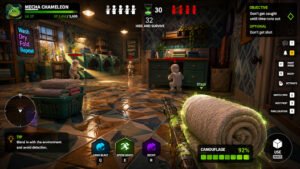
Mecha Chameleon Game Strategies: Hide Better, Search Smarter
Welcome to GameReal.online, your destination for gaming guides, tips, strategies, and the latest gaming content. If you enjoy games that combine creativity, observation, camouflage, and multiplayer competition, Mecha Chameleon offers a unique experience worth exploring.
Mecha Chameleon takes the familiar idea of hide-and-seek and turns it into a more strategic multiplayer experience. Players need to think carefully about where they hide, how they blend into the environment, when they should move, and how they can avoid being discovered. On the other side, seekers need to examine the environment carefully and identify anything that looks unusual.
This guide, Mecha Chameleon Game Strategies: Hide Better, Search Smarter, focuses on practical strategies that can help both new and experienced players. Whether you prefer hiding in plain sight or searching every corner of the map, understanding the fundamentals can make your matches more enjoyable and competitive.
What Is Mecha Chameleon?
Mecha Chameleon is a multiplayer hide-and-seek style game built around camouflage and observation. Instead of simply finding a hiding location and waiting, players can use the surrounding environment to make themselves difficult to recognize.
The game creates two different challenges. Hiders must become part of their environment, while seekers must learn to identify visual clues that reveal hidden players.
This simple concept creates plenty of opportunities for strategy. A good hiding location can make a player almost impossible to notice, while a good seeker can identify tiny differences that other players completely miss.
Why Strategy Matters in Mecha Chameleon
At first, Mecha Chameleon may seem like a game based entirely on luck. However, experienced players quickly discover that strategy has a major impact on the outcome of a round.
Hiders need to consider color, position, shape, lighting, movement, and the perspective of the seeker. Seekers need to understand map layouts, recognize suspicious details, and search efficiently.
| Strategy Area | Important Skill |
|---|---|
| Hiding | Camouflage and positioning |
| Searching | Observation |
| Survival | Patience and timing |
| Map Knowledge | Understanding common locations |
| Mind Games | Predicting opponent behavior |
Understanding the Hider’s Objective
When playing as a hider, your main objective is simple: remain undiscovered according to the rules of the current game mode.
However, achieving that objective requires more than finding a dark corner. You need to choose a location where your character looks natural.
A successful hider thinks about what the seeker will see rather than what the hider sees.
Think Like the Seeker
Before choosing a hiding spot, ask yourself a few questions:
- Would I check this location if I were searching?
- Does my color match the surroundings?
- Does my character’s shape look natural here?
- Can I remain still in this position?
- Will the lighting make me stand out?
- Can the seeker see this area easily from another direction?
These questions can help you avoid many common beginner mistakes.
Strategy 1: Study the Map Before Hiding
One of the best strategies for hiders is to understand the map before making a decision.
Look at the environment and identify areas with different colors, patterns, structures, and objects. Do not immediately choose the closest hiding location.
A few seconds spent studying the environment can make a significant difference.
Learn Common Hiding Areas
After playing several rounds, you will begin to notice locations that players frequently use. These may include corners, furniture, walls, decorations, or other areas that naturally provide camouflage.
Remember these locations not only as potential hiding places but also as places to search when you become a seeker.
Strategy 2: Match Your Color
Color is one of the most important elements of camouflage.
If you are standing next to a dark surface, a bright color can make you immediately noticeable. If the surrounding environment contains neutral colors, a similar tone may help you blend in.
However, do not focus only on the basic color. Pay attention to shades, shadows, textures, and lighting.
| Environment | General Camouflage Idea |
|---|---|
| Dark surface | Use a darker appearance when possible. |
| Light surface | Choose a lighter appearance. |
| Wooden area | Look for brown and natural tones. |
| Green environment | Consider green or similar natural tones. |
| Mixed-color area | Choose a location where your overall appearance fits the pattern. |
The goal is not necessarily to become perfectly invisible. The goal is to avoid immediately attracting the seeker’s attention.
Strategy 3: Pay Attention to Your Shape
Even if your color is excellent, your shape can reveal you.
Imagine a wall with a simple, flat pattern. If your character creates an obvious outline against that wall, the seeker may recognize you quickly.
Try to position your character where the surrounding objects help break up your outline.
Strategy 4: Hide in Plain Sight
Sometimes the best hiding location is not the most secret location.
Players often expect hiders to choose dark corners or difficult-to-reach locations. A character that blends naturally into an ordinary part of the environment may sometimes be overlooked.
This strategy works because seekers may focus on locations that look suspicious while ignoring objects that appear completely normal.
Don’t Become Predictable
If you successfully hide in plain sight once, do not assume the same strategy will work every round. Other players may remember your previous location.
Changing your strategy keeps opponents guessing.
Strategy 5: Stay Completely Still
Movement can destroy good camouflage.
Once you find a strong hiding position, avoid unnecessary movement. Even a small movement at the wrong moment can attract attention.
This is especially important when a seeker is close to your location.
Instead of panicking and moving away, remain calm and allow the seeker to continue searching.
Strategy 6: Understand Lighting
Lighting can significantly affect how camouflage looks.
A color that appears similar to a wall in a bright area may look completely different in a shadow. Therefore, consider how your character looks from the perspective of someone approaching from another direction.
Good hiders learn to evaluate their hiding position from multiple angles.
Strategy 7: Use the Seeker’s Perspective
One of the most powerful techniques is to think about what the seeker is likely to see.
Ask yourself where the seeker will probably walk and what areas they are likely to inspect first.
A location that looks excellent from your current position may be obvious from another direction.
| Hider Question | Why It Matters |
|---|---|
| Can the seeker see me from the entrance? | Helps identify exposed positions. |
| Does my outline look unusual? | Prevents visual detection. |
| Does my color fit the environment? | Improves camouflage. |
| Will I need to move? | Reduces the chance of accidental movement. |
| Is this a common hiding location? | Helps avoid predictable strategies. |
How to Search Smarter as a Seeker
When you become the seeker, your strategy changes completely.
Your objective is not simply to move around the map as quickly as possible. You need to observe carefully and identify players who are attempting to blend into their surroundings.
The best seekers combine patience with systematic searching.
Strategy 8: Search Systematically
Randomly running around the map may feel fast, but it can cause you to overlook important details.
Instead, divide the map into sections and search each section carefully.
For example, you can search one side of the map first, then move to another section. This reduces the chance of repeatedly checking the same areas while ignoring others.
Use a Search Pattern
- Start with one section.
- Check obvious hiding locations.
- Examine nearby objects.
- Look for unusual colors.
- Watch suspicious areas for movement.
- Move to the next section.
Strategy 9: Look for Things That Do Not Belong
Instead of asking, “Where is the player?” ask, “What looks wrong?”
This small change in thinking can dramatically improve your ability to find hidden players.
A hidden player may look almost identical to the environment, but small differences can still be visible.
Things to Watch For
- Unexpected colors.
- Unusual shapes.
- Objects that appear slightly displaced.
- Strange shadows.
- Unexpected movement.
- Patterns that do not match the environment.
Strategy 10: Watch for Movement
Movement is one of the strongest clues available to seekers.
A hider may remain still for a long time but eventually move because they become nervous, need to adjust their position, or believe the seeker has moved away.
If you see something move in an unusual location, investigate it carefully.
Strategy 11: Don’t Rush Suspicious Areas
If you notice something suspicious, do not immediately move away because you are unsure.
Stop and observe.
Sometimes a player will reveal themselves through movement. Patience can turn a suspicious location into a confirmed discovery.
Strategy 12: Remember Player Habits
Multiplayer games often develop patterns. Players may prefer certain locations or strategies.
If you notice that a particular player frequently hides in corners, check corners more carefully in future rounds. If someone always chooses bright surfaces, remember that pattern.
However, good players will also change their strategies, so never rely entirely on previous behavior.
Hiding Strategies for Different Environments
Different environments require different approaches. Your strategy should change depending on the colors, objects, and structures around you.
| Environment Type | Possible Strategy |
|---|---|
| Wooden Area | Look for natural brown tones and wooden structures. |
| Stone Area | Consider gray and neutral surfaces. |
| Colorful Area | Find a section where your overall appearance fits the pattern. |
| Dark Area | Use shadows and darker surroundings carefully. |
| Open Area | Look for natural-looking objects or surfaces rather than exposed positions. |
How to Avoid Predictable Hiding
Predictability is dangerous.
If you always choose the same type of hiding location, experienced players may start searching those locations first.
Try changing your strategy regularly.
One round you might hide near a wall. Another round you might choose a decorative area. Another time you might attempt to blend into a larger surface.
The goal is to make it difficult for other players to predict your next move.
Mind Games in Mecha Chameleon
Mecha Chameleon is not only about visual camouflage. It can also involve psychological strategy.
Players naturally develop expectations. If everyone believes that hiders will choose difficult locations, hiding somewhere ordinary may become effective.
Similarly, if seekers always check the most obvious areas first, a clever hider may take advantage of that behavior.
This creates a simple form of mind game between hiders and seekers.
Advanced Hider Strategy: Predict the Search Route
Experienced hiders can try to predict the route the seeker will take.
Think about the map layout. Which areas will the seeker probably reach first? Which areas are easiest to inspect? Which locations might be ignored because they appear unimportant?
Choosing a hiding spot based on the likely search route can increase your chances of surviving longer.
Advanced Seeker Strategy: Change Your Search Pattern
If you always search the map in the same order, experienced hiders may learn your pattern.
Change your route occasionally. Search different sections first and approach common hiding areas from different directions.
Unpredictable searching can make it more difficult for hiders to anticipate your movements.
How to Improve Your Map Knowledge
Map knowledge comes naturally with experience, but you can speed up the process by actively studying the environment.
During each match, remember important locations and visual features. Notice which areas contain similar colors and which locations provide good camouflage.
Over time, you will develop a mental map that can help you both hide and search.
Common Mistakes Hiders Should Avoid
Hiding Too Quickly
Running to the first available location may result in poor camouflage. Take a moment to examine your surroundings.
Moving When the Seeker Is Nearby
Unnecessary movement can immediately reveal your position.
Using the Same Spot Repeatedly
Repeated strategies become predictable.
Ignoring Your Outline
Even a good color match may fail if your shape looks unnatural.
Forgetting the Lighting
A location may look good from one angle but obvious from another.
Common Mistakes Seekers Should Avoid
Searching Too Quickly
Speed can cause you to miss small details.
Ignoring Suspicious Objects
If something looks slightly unusual, investigate it.
Checking Only Obvious Locations
Experienced players may intentionally avoid common hiding spots.
Using the Same Search Route
Predictable search patterns can be exploited by experienced hiders.
Mecha Chameleon Strategy Checklist
| Task | Hider | Seeker |
|---|---|---|
| Study the map | Yes | Yes |
| Watch colors | Match them | Look for differences |
| Watch movement | Avoid it | Look for it |
| Use patience | Stay still | Observe carefully |
| Change strategy | Frequently | Frequently |
| Learn player habits | Avoid becoming predictable | Use patterns as clues |
How to Practice and Improve
The fastest way to become better at Mecha Chameleon is to play both roles regularly.
When you play as a hider, pay attention to what causes you to get discovered. When you play as a seeker, pay attention to the clues that help you find other players.
After each round, ask yourself what you could have done differently.
Questions to Ask After a Round
- Was my hiding location too obvious?
- Did my color match the environment?
- Did I move unnecessarily?
- Did the seeker approach from an unexpected direction?
- What clue helped me find another player?
- Did I search too quickly?
- Did I repeat the same strategy?
Playing Mecha Chameleon With Friends
Playing with friends can make the game even more entertaining. Friends may develop completely different strategies, making every round unpredictable.
You can also create friendly challenges. For example, players can compete to see who can remain hidden the longest or who can find hidden players most quickly.
Friendly multiplayer sessions are also a great way for beginners to learn the mechanics without feeling pressured to perform perfectly.
Best Strategies for New Players
If you are completely new to the game, do not try to learn every advanced technique immediately.
Start with these five basic principles:
- Learn the map.
- Match your surroundings.
- Stay still when hiding.
- Search carefully when seeking.
- Change your strategy regularly.
Once these become natural, you can begin experimenting with more advanced mind games and positioning strategies.
Advanced Strategy: Combine Multiple Techniques
The strongest players do not rely on one strategy. They combine multiple techniques.
A good hider may choose a naturally colored location, position themselves carefully, avoid movement, and select a place that the seeker is unlikely to inspect early.
A good seeker may search systematically, watch suspicious areas, remember player habits, and change their route to avoid predictable behavior.
The combination of these techniques is what makes Mecha Chameleon more strategic than a simple game of hiding.
Why Practice Matters
Experience is extremely valuable in a camouflage-based game. The more maps and rounds you play, the better you become at recognizing visual patterns.
Eventually, you may start noticing suspicious details almost automatically.
You will also learn which hiding locations work well and which locations are usually checked by experienced seekers.
Final Mecha Chameleon Strategy Guide
| Strategy | Best For | Difficulty |
|---|---|---|
| Color Matching | Hiders | Easy |
| Staying Still | Hiders | Easy |
| Map Knowledge | Both | Medium |
| Systematic Searching | Seekers | Medium |
| Predicting Opponents | Both | Advanced |
| Mind Games | Both | Advanced |
Final Thoughts
Mecha Chameleon Game Strategies: Hide Better, Search Smarter is all about understanding the difference between simply playing and playing strategically.
As a hider, your goal is not just to disappear. You need to become part of the environment. Study colors, shapes, lighting, positions, and movement. Choose locations carefully and avoid becoming predictable.
As a seeker, your job is not simply to run around the map. Search intelligently. Look for things that do not belong, watch for movement, remember common hiding locations, and use a systematic search pattern.
The most important lesson is to learn from both sides of the game. Playing as a seeker teaches you how players get discovered. Playing as a hider teaches you how seekers think.
With practice, you will become better at recognizing small visual differences, predicting player behavior, and choosing effective strategies.
Whether you are playing casually with friends or trying to become a highly skilled player, the combination of camouflage, observation, patience, and strategy makes Mecha Chameleon an entertaining multiplayer experience.
Keep visiting GameReal.online for more gaming guides, gameplay strategies, tips, tricks, and gaming content.
Quick Mecha Chameleon Strategy Guide
| Role | Top Strategy | Key Skill |
|---|---|---|
| Hider | Blend into the environment | Camouflage |
| Hider | Stay still | Patience |
| Hider | Change hiding locations | Unpredictability |
| Seeker | Search systematically | Observation |
| Seeker | Watch suspicious areas | Attention |
| Seeker | Learn player habits | Prediction |
Conclusion
Mecha Chameleon rewards players who can think carefully, observe their surroundings, and adapt their strategies. The best hiders know when to disappear into the environment, while the best seekers know where and how to look.
Start with the basics, practice regularly, learn the maps, and experiment with different approaches. Over time, you will discover your own favorite hiding techniques and searching strategies.
Remember: hide better, search smarter, stay unpredictable, and keep practicing.
GameReal.online — Your Gaming Guide for Tips, Strategies and More.